Email Marketing

Email Marketing

Email Design Best Practices for Higher Engagement (2026 Guide)

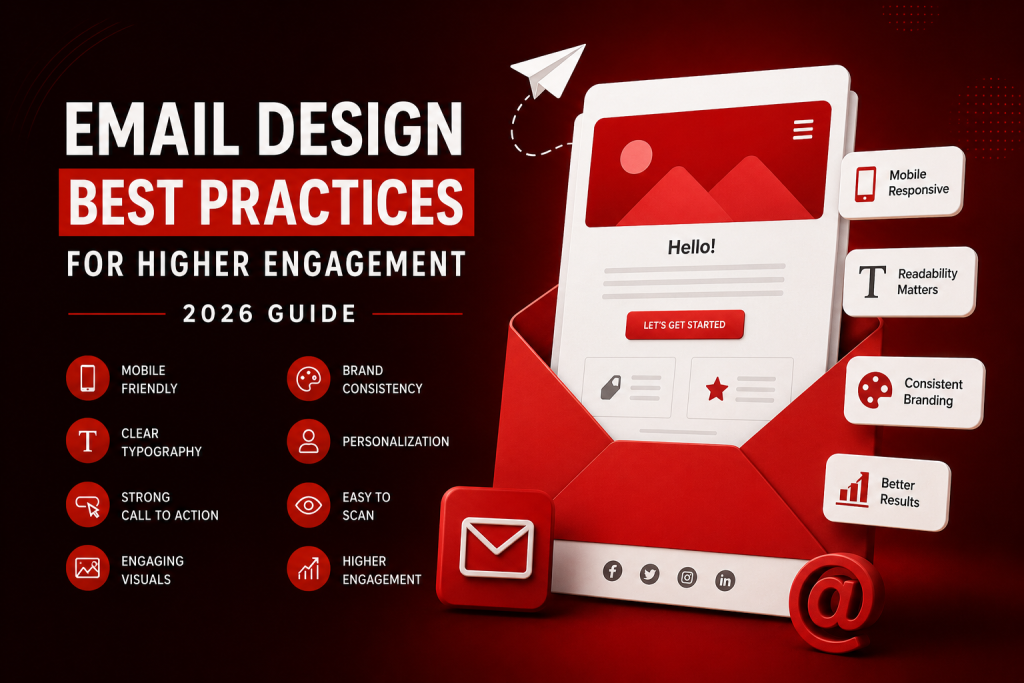
Meta Title: Email Design Best Practices for Higher Engagement (2026) Meta Description: Learn proven email design best practices to boost opens, clicks, and conversions in 2026. Includes checklist, examples, and expert tips. URL Slug: /email-design-best-practices Focus Keyword: Email Design Best Practices Introduction Open your inbox right now. Count how many emails you skip without reading past the subject line. Now think about your own campaigns. That gap between “sent” and “actually read” is almost always a design problem, not a copy problem. Email design is the first impression your brand makes every single time you hit send. Before a subscriber reads a word of your offer, they’ve already judged your layout, your colors, and whether your email looks trustworthy or like spam. Industry benchmarks vary by sender and list quality, but marketers consistently report that clean, mobile-friendly, well-structured emails outperform cluttered ones on opens, clicks, and conversions. Design isn’t decoration. It’s function. This guide breaks down everything you need to build emails that people actually want to open, read, and click. You’ll learn why design matters, the 25 best practices used by top-performing brands, the most common mistakes killing your engagement, and how to build a repeatable checklist your whole team can follow. Whether you run an e-commerce store, a SaaS product, an agency, or a growing blog, the principles here apply. Let’s get into it. Table of Contents Why Email Design Matters First impressions happen in seconds A subscriber decides whether your email is worth their time before they finish reading the first line. A messy layout, a broken image, or text that’s too small signals “not worth it” almost instantly. User experience drives every metric that follows If a reader has to pinch, zoom, or scroll sideways to read your email, they won’t. Good design removes friction between “opened” and “took action.” Brand trust is built visually Consistent colors, fonts, and layout tell subscribers this email is really from you, not a phishing attempt. That trust is what allows people to click links confidently. Readability affects comprehension Dense paragraphs and tiny fonts slow readers down. Clear hierarchy and short blocks of text help people scan and absorb your message in seconds. Conversions depend on clarity A confusing layout buries your call to action. A well-designed email guides the eye naturally toward the next step you want the reader to take. Retention is a long game Subscribers who consistently have a good experience with your emails are more likely to stay subscribed, open future campaigns, and become repeat customers. Benefits of Good Email Design 25 Email Design Best Practices 1. Design Mobile-First Why it matters: Most subscribers open email on their phones first. If your layout breaks on mobile, you lose the majority of your audience before they read a word. Best Practices: Start your design process on a mobile-sized canvas (600px or narrower), then scale up for desktop. Use single-column layouts and large tappable buttons. Common Mistakes: Designing for desktop first and treating mobile as an afterthought; using tiny buttons that are hard to tap. Expert Tips: Test every email on an actual phone screen before sending, not just a preview tool. 2. Use Responsive Layouts Why it matters: Subscribers use dozens of email clients and screen sizes. A responsive layout adapts automatically instead of forcing a one-size-fits-all design. Best Practices: Use fluid or hybrid coding techniques with media queries so columns stack on smaller screens. Common Mistakes: Relying purely on fixed-width tables without fallback behavior for smaller screens. Expert Tips: Build with a hybrid fluid layout so the email still looks acceptable even in clients that ignore media queries. 3. Keep the Layout Clean Why it matters: Cluttered emails overwhelm readers and bury your main message. Best Practices: Stick to one primary message per email, with supporting content clearly secondary. Common Mistakes: Cramming multiple offers, banners, and CTAs into a single email. Expert Tips: If you can remove an element without losing meaning, remove it. 4. Use White Space Generously Why it matters: White space (empty space) gives the eye room to rest and helps readers focus on what matters. Best Practices: Add generous padding around text blocks, images, and buttons. Common Mistakes: Squeezing elements together to fit more content above the fold. Expert Tips: When in doubt, add more spacing, not less. Cramped emails feel cheap. 5. Choose Readable Typography Why it matters: Typography affects how quickly and comfortably people read your message. Best Practices: Use web-safe fonts like Arial, Helvetica, or Georgia, with fallbacks for custom fonts. Common Mistakes: Using decorative or script fonts for body text. Expert Tips: Limit yourself to two font families per email: one for headings, one for body text. 6. Use Appropriate Font Sizes Why it matters: Small text is hard to read on mobile, especially for older audiences. Best Practices: Use at least 14–16px for body text and 22px or larger for headings. Common Mistakes: Using 10–12px fonts to fit more copy into the email. Expert Tips: Increase line height (1.4–1.6) alongside font size for better readability. 7. Apply Color Psychology Thoughtfully Why it matters: Colors influence mood and can nudge behavior, from urgency to trust. Best Practices: Choose a primary brand color, an accent color for CTAs, and neutral tones for backgrounds and text. Common Mistakes: Using too many competing colors that create visual noise. Expert Tips: Reserve your boldest color exclusively for the call-to-action button so it stands out. 8. Maintain Brand Consistency Why it matters: Consistency across emails, your website, and other channels builds recognition and trust. Best Practices: Use the same logo placement, color palette, and tone of voice in every campaign. Common Mistakes: Changing templates or styles frequently, confusing subscribers about who sent the email. Expert Tips: Build a locked template library so every team member sends on-brand emails. 9. Design Clear CTA Buttons Why it matters: The CTA button is the single most important design element — it’s where conversions happen. Best Practices: Use a solid, high-contrast button with clear action-oriented text

Email Marketing

Email Copywriting Tips

Email Copywriting Tips: Write Emails That Get Opened, Read, and Convert SEO Metadata ●        SEO Title: Email Copywriting Tips: Write Emails That Convert (2026) ●        Meta Description: Discover proven email copywriting tips to boost open rates, clicks, and sales. Real examples, formulas, and templates included. ●        URL Slug: /email-copywriting-tips ●        Primary Keyword: Email Copywriting Tips ●        Word Count Target: 4,000–5,500 words Table of Contents ●        What Is Email Copywriting? ●        Why Email Copywriting Matters ●        The Psychology Behind High-Converting Emails ●        Know Your Audience Before Writing ●        How to Write Irresistible Subject Lines ●        Write an Engaging Preview Text ●        Write a Powerful Opening Line ●        Keep Email Copy Simple and Readable ●        Focus on Benefits, Not Features ●        Master the Art of Storytelling ●        Create Strong Calls-to-Action ●        Personalization Techniques That Increase Conversions ●        Email Copywriting Formulas ●        Different Types of Marketing Emails ●        30 Email Copywriting Tips That Actually Work ●        Common Email Copywriting Mistakes ●        Best Email Copywriting Tools ●        Real Email Copy Examples ●        A/B Testing Email Copy ●        Email Metrics to Track ●        The Future of Email Copywriting ●        Pro Tips from Professional Email Copywriters ●        Frequently Asked Questions ●        Conclusion Key Takeaways ●        Email copywriting is persuasive, benefit-driven writing built to earn an open, a click, and a conversion — not just informative writing. ●        Subject lines and preview text decide whether the rest of your email ever gets read, so they deserve as much effort as the body copy. ●        Proven psychological triggers — curiosity, urgency, scarcity, social proof, and personalization — consistently lift open and click rates. ●        Classic copywriting formulas like AIDA, PAS, and BAB give you a repeatable structure for any campaign. ●        Every email should have exactly one clear, benefit-focused call-to-action. ●        Testing and tracking the right metrics is how good email copy becomes great email copy over time. Introduction A well-written email can outperform a paid ad campaign, a social post, and a blog article combined — and it costs almost nothing to send. That is why email marketing consistently ranks among the highest-ROI channels available to businesses of every size, from solo freelancers to global SaaS companies. Yet most inboxes are crowded, attention spans are short, and a single weak subject line can send months of list-building effort straight to the trash folder. Picture this: you spend hours crafting the perfect offer, hit send to five thousand subscribers, and the open rate barely clears 12%. The problem almost never lies in the offer itself — it lies in the copy. Words are the entire product when it comes to email. There is no photography, no video, no salesperson standing beside the reader. Just a subject line, a few lines of preview text, and a block of copy competing for attention against dozens of other unread messages. This guide breaks down exactly how professional email copywriters think, structure, and write emails that get opened, read, and clicked. You will learn the psychology behind high-converting copy, proven formulas used by top marketers, real subject line and CTA examples you can adapt today, and the mistakes that quietly kill conversions. Whether you are writing your first welcome sequence or refining a mature lifecycle program, these email copywriting tips will help you write with more clarity, more persuasion, and more measurable results. What Is Email Copywriting? Email copywriting is the practice of writing persuasive, purposeful text specifically designed to prompt a reader to take action — opening the email, clicking a link, making a purchase, or replying. It sits at the intersection of marketing psychology, brand voice, and direct-response writing. Email writing simply conveys information: a newsletter update, a policy change, a shipping confirmation. Email copywriting goes further. Every sentence is built around a goal, every word is chosen for impact, and every element — subject line, preview text, opening line, body, and CTA — works together to move the reader toward a single next step. Persuasive writing matters because attention is the scarcest resource in a subscriber’s inbox. A reader decides whether to open your email in under two seconds, largely based on the subject line and sender name. Copywriting is what turns a passive scan into an active decision. Why Email Copywriting Matters Strong email copywriting directly affects the metrics that determine whether your email program is profitable. ●        Higher open rates: Compelling, curiosity-driven subject lines consistently outperform generic ones. ●        More clicks: Clear, benefit-focused body copy with a single strong CTA drives significantly more click-throughs than vague, feature-heavy copy. ●        Increased conversions: Persuasive copy that addresses objections and creates urgency turns clicks into completed purchases or sign-ups. ●        Better customer relationships: Emails written in a genuine, conversational voice build familiarity and trust over time. ●        Stronger brand trust: Consistent, honest, well-written communication signals professionalism and reliability. ●        Improved ROI: Because email has no ad spend or platform fees, even modest copy improvements produce outsized returns compared to paid channels. Industry benchmarks vary by sector, but marketers consistently find that segmented, well-written campaigns outperform generic blasts by a wide margin, and that subject line testing alone can shift open rates by several percentage points. The lesson: copy quality is not a nice-to-have, it is one of the biggest levers available in email marketing. The Psychology Behind High-Converting Emails Every high-converting email leans on one or more psychological triggers. Understanding these gives you a toolkit you can apply to any subject line, opening line, or CTA. ●        Curiosity: An open loop the reader wants closed — “You’re doing this wrong (and don’t even know it).” ●        Scarcity: Limited quantity increases perceived value — “Only 12 left in stock.” ●        Urgency: A closing window prompts immediate action — “Offer ends tonight at midnight.” ●        Trust: Transparency, testimonials, and consistency reduce perceived risk. ●        Reciprocity: Giving something valuable first (a tip, a discount, a resource) makes readers more willing to act. ●        Social proof: Numbers, reviews, and peer behavior reduce hesitation — “Join 40,000 marketers already subscribed.” ●        Personalization: Copy that

Email Marketing

Email Marketing Trends 2026

Email Marketing Trends 2026 Top Trends, Strategies, and Predictions Every Business Should Know A complete guide for marketers, business owners, and brands who want higher open rates, stronger engagement, and better ROI in 2026. SEO Elements (For Your Website / Elementor / Yoast Fields) Use these fields directly in your Elementor page settings or SEO plugin (Yoast/Rank Math) when you publish this post. SEO Title: Email Marketing Trends 2026: Top Strategies & Predictions Meta Title: Email Marketing Trends 2026 | Strategies, Tools & Predictions Meta Description: Discover the top email marketing trends 2026: AI personalization, automation, zero-party data & more. Boost open rates, ROI & engagement today. URL Slug: /email-marketing-trends-2026 Social Media Meta Title: Email Marketing Trends 2026: What Every Business Must Know Social Media Description: AI, hyper-personalization, zero-party data & interactive emails are reshaping inboxes in 2026. Here’s how to stay ahead and grow your ROI. Table of Contents (In Word, right-click the table above and choose “Update Field” to populate it. On your Elementor site, you can recreate this as an anchor-link list, or use an Elementor Table of Contents widget pointed at the headings below.) Introduction Email marketing has been declared “dead” almost every year since social media exploded onto the scene — and every year, it proves the opposite. In 2026, email remains one of the highest-ROI channels in all of digital marketing, with businesses reporting returns of roughly $36 to $45 for every $1 spent, according to data compiled by Litmus, Omnisend, and DemandSage. That is a return most other channels simply cannot match, whether you’re comparing it to paid search, social advertising, or display ads. But the email marketing of 2026 looks very different from the newsletters and blast campaigns of even three or four years ago. Three forces are reshaping the inbox right now. First, artificial intelligence has moved from a novelty to the backbone of modern email programs — writing subject lines, predicting the best send time, and personalizing content block by block for every single subscriber. Second, privacy regulations and the death of third-party cookies have pushed marketers toward zero-party and first-party data, meaning brands now have to earn information directly from customers rather than track it silently. Third, customer expectations have shifted: subscribers want emails that feel relevant, timely, and human — not generic broadcasts. If you run a business, manage a brand’s marketing, or write content for clients, understanding these shifts isn’t optional anymore. Companies that adapt early are seeing meaningfully higher engagement and revenue per send, while those that keep sending the same static newsletters are watching open rates slide and unsubscribe rates climb. In this guide, you’ll learn what email marketing looks like in 2026, the twelve biggest trends shaping the industry, the tools worth your budget, the strategies that actually move the needle, the mistakes still tripping up otherwise smart marketers, and where the channel is headed beyond 2026. Whether you’re a solo blogger, an eCommerce founder, or a SaaS growth marketer, you’ll walk away with a clear, actionable playbook. What Is Email Marketing? Email marketing is the practice of sending targeted, permission-based messages to a list of subscribers with the goal of building relationships, nurturing leads, and driving sales. Unlike social media or paid ads, it relies on a channel your business actually owns — your email list isn’t subject to an algorithm change or a platform ban. How It Works A typical email marketing program has four moving parts: list building (collecting subscriber emails through opt-in forms, lead magnets, or checkout flows), segmentation (grouping subscribers by behavior, demographics, or lifecycle stage), content and automation (the actual emails — newsletters, promotions, and triggered sequences), and analytics (tracking opens, clicks, conversions, and revenue to refine future campaigns). Why Businesses Still Rely on Email Marketing It’s a direct line to the customer with no algorithm standing in the way. It scales efficiently — sending to 10,000 people costs barely more than sending to 100. It produces measurable, attributable revenue, unlike many brand-awareness channels. It supports the entire customer journey, from first touch to loyal repeat buyer. Benefits Over Other Marketing Channels Compared with social media, email delivers substantially higher conversion rates — recent benchmark data puts email conversion rates around 4.2%, compared with under 1% for social traffic. Compared with paid search, email has no ongoing cost-per-click; once someone is on your list, reaching them again is nearly free. And unlike organic reach on social platforms, which keeps shrinking, your email list is a durable, owned asset that keeps compounding in value as it grows. Why Email Marketing Is Still Important in 2026 Despite predictions of its decline, email marketing keeps earning its place at the center of the marketing stack. Here’s what the current data shows about why it still matters so much. ROI Statistics Email marketing delivers an average return of roughly $36–$45 for every $1 spent — the highest ROI of any digital marketing channel, according to Litmus and Omnisend benchmark data. Retail, eCommerce, and consumer goods brands see some of the strongest returns, with reported ROI as high as 4,500%. Around 30% of marketers rate email as their single highest-ROI channel, with another 43% rating it as medium-ROI — a consistency few other channels can claim. Automated emails, while representing a small share of total volume, are responsible for a disproportionately large share of email-driven revenue. Customer Retention Email shines brightest after the first sale. Lifecycle emails — post-purchase sequences, replenishment reminders, loyalty updates — keep your brand top-of-mind without the cost of re-acquiring a customer through ads. Retaining an existing customer is dramatically cheaper than acquiring a new one, and email is the most cost-effective tool for doing it. Lead Nurturing Not every visitor buys on the first visit. Automated nurture sequences — welcome series, educational drips, cart abandonment flows — keep leads warm and gradually move them toward a purchase decision, often converting people who would otherwise be lost after a single site visit. Direct Communication There’s no algorithm deciding

Email Marketing

AI in Email Marketing

AI in Email Marketing: The Ultimate Guide to Smarter Campaigns, Automation & Higher Conversions (2026) Introduction Email marketing has always been one of the highest-return channels available to businesses, but for most of its history it has also been one of the most manual. Marketers wrote every subject line by hand, guessed at send times, and segmented lists using rough categories like “past customers” or “newsletter subscribers.” That era is ending. AI in email marketing has moved from a novelty feature buried inside enterprise software to the core engine behind how modern campaigns are planned, written, sent, and optimized. The shift is not just about saving time, although that matters. It is about a fundamentally different way of running campaigns. Instead of sending the same email to everyone on a list at the same time, AI-powered email marketing platforms analyze individual subscriber behavior and decide, person by person, what content to show, which subject line to use, and when to hit send. The result is campaigns that feel personal at a scale that would be impossible for a human team to manage manually. This transformation touches every stage of the email lifecycle. Predictive analytics forecast which subscribers are likely to churn before they unsubscribe. Generative AI drafts email copy and subject lines in seconds. Machine learning models score leads, segment audiences, and rank products for recommendation blocks. Real-time optimization engines test and adjust campaigns while they are still running, rather than waiting for a post-campaign report. In this guide, you will learn what AI in email marketing actually means, how it works under the hood, the specific features and tools reshaping the industry in 2026, and a step-by-step framework for putting AI to work in your own campaigns. Whether you run a solo blog, manage marketing for a growing SaaS company, or handle email for an agency juggling multiple clients, this guide is built to give you a practical, no-fluff path to smarter, higher-converting email marketing. Table of Contents     What Is AI in Email Marketing? AI in email marketing refers to the use of machine learning, natural language processing, and predictive analytics to plan, create, personalize, send, and optimize email campaigns with minimal manual effort. Rather than relying on static rules like “send this email to everyone who signed up last month,” AI systems continuously learn from subscriber behavior and adjust campaigns automatically. Definition At its core, AI-powered email marketing is software that uses data-driven models to make decisions that used to require a human marketer: what to say, who to say it to, and when to say it. These decisions are informed by historical open rates, click patterns, purchase history, browsing behavior, and even the time of day a subscriber is statistically most likely to engage. How AI Works in Email Marketing AI email tools ingest data from multiple sources, including your CRM, website analytics, e-commerce platform, and past campaign performance. Machine learning models then look for patterns in that data, such as which subscribers are about to churn, which products a specific customer is likely to buy next, or which subject line style performs best with a given audience segment. Those patterns feed into automated decisions, like which email variant to send or when to trigger a follow-up. Difference Between Traditional and AI-Powered Email Marketing Traditional email marketing relies on broad segmentation, fixed send schedules, and manually written content that is the same for every recipient in a segment. AI-powered email marketing replaces these fixed rules with dynamic, individualized decisions. A traditional campaign might segment by “location: US” and send at 9 a.m. Eastern for everyone. An AI-powered campaign might send to each subscriber at their personal predicted best-engagement time, with subject lines and product recommendations tailored to that individual. Why Businesses Are Adopting AI in Email Marketing Inboxes are more crowded and attention spans are shorter than ever, which makes relevance the deciding factor in whether an email gets opened or ignored. Businesses are adopting AI email marketing because it directly addresses this problem: it makes every email more relevant to the person receiving it, without requiring a marketing team to manually build hundreds of segment-specific campaigns. It also compresses the time between an idea and a live campaign, letting lean teams compete with far larger ones. How AI Is Transforming Email Marketing AI touches nearly every part of the email marketing workflow. Below are the areas where the impact is most visible. Automated Campaign Creation Modern AI email platforms can generate a full campaign, subject line, body copy, layout suggestions, and even calls to action, from a short prompt describing the goal. Marketers still review and refine the output, but the first draft that used to take hours now takes minutes. Predictive Analytics Predictive models analyze historical engagement data to forecast future behavior, such as the likelihood a subscriber will open the next email, make a purchase, or unsubscribe. This lets marketers act before a problem occurs, for example by sending a win-back campaign to an at-risk subscriber before they go completely silent. Personalized Recommendations Recommendation engines, similar to the ones used by large e-commerce platforms, analyze browsing and purchase history to suggest specific products or content in each email, rather than showing every subscriber the same generic featured-products block. Behavioral Targeting AI tracks actions such as page visits, cart activity, and email engagement, then triggers relevant follow-up messages automatically. A subscriber who viewed a product three times but did not buy might receive a different message than one who added the item to their cart and abandoned it. Dynamic Content Dynamic content blocks change based on who is viewing the email. The same campaign can show different images, offers, or product recommendations depending on the recipient’s location, past purchases, or engagement history, all generated from a single template. Intelligent Segmentation Instead of manually building segments, AI clusters subscribers based on hundreds of behavioral and demographic signals, surfacing groups that a human marketer might never think to create manually, such as “high engagement

Email Marketing

Email Automation Guide

Email Automation Guide: The Complete Beginner-to-Advanced Guide for 2026 Right now, somewhere in your business, a lead is going cold. Someone downloaded your ebook, added a product to their cart, or signed up for your newsletter — and then nothing happened. No follow-up. No nurture. No second chance. That gap between “someone showed interest” and “someone took action” is where most businesses quietly lose money, and it is exactly what a good email automation guide should help you fix. Email automation is not a buzzword anymore. It is the backbone of modern marketing. Whether you run a one-person blog, a fast-growing SaaS company, or a busy eCommerce store, automated emails work while you sleep, nurturing leads, recovering abandoned carts, and turning one-time buyers into repeat customers. And the businesses that get this right are not necessarily the ones with the biggest budgets — they are the ones with the smartest workflows. This guide is built for beginners who have never touched an automation tool, as well as marketers who want to sharpen advanced strategies like behavioral triggers and AI personalization. By the end, you will understand what email automation is, why it matters, how it works step by step, which tools are worth your money, and how to build workflows that actually convert. We will also cover common mistakes, a practical checklist, and answers to the questions people ask most often. If you have ever wondered how top brands seem to send the “perfect” email at exactly the right moment, this is how they do it — and by the time you finish reading, you will know how to do it too. Table of Contents     What Is Email Automation? Email automation is the process of sending targeted emails to subscribers automatically, based on triggers, schedules, or specific actions they take — without a human manually clicking “send” every time. Instead of writing and sending each email one by one, you build a workflow once, and the system takes care of the rest. Think of it as setting up a series of dominoes. You define the trigger (someone joins your list), the sequence (a welcome email, followed by a product tour, followed by a special offer), and the conditions (only send the offer if they have not purchased yet). Once it is live, the workflow runs continuously, reacting to real subscriber behavior in real time. How It Works At its core, every email automation system needs three components: a trigger, a workflow, and an action. The trigger is the event that starts everything — a sign-up, a purchase, a click, or even a date on the calendar. The workflow is the logic that decides what happens next, including delays, conditions, and branches. The action is the actual email (or SMS, or notification) that gets sent to the subscriber. Why Businesses Use It Businesses adopt email automation because manual email marketing simply cannot scale. A single marketer can personally write a handful of emails a day, but an automation system can send thousands of perfectly timed, personalized emails simultaneously — to a first-time visitor and a five-year loyal customer, with entirely different messaging, at the exact same moment. Manual Email vs. Automated Email Factor Manual Email Automated Email Time investment High — sent one at a time Low — set up once, runs continuously Timing Depends on when the marketer is available Instant, based on real-time triggers Personalization Limited, hard to scale Deep, based on behavior and data Consistency Inconsistent, easy to forget follow-ups Consistent and reliable every time Scalability Difficult beyond a small list Scales to thousands or millions of contacts   Key Benefits at a Glance ●       Saves hours of repetitive manual work every week ●       Delivers the right message at the right moment ●       Nurtures leads automatically without manual follow-up ●       Improves the overall customer experience ●       Increases revenue through timely offers and reminders Why Email Automation Matters Email remains one of the highest-return marketing channels available, and automation is what unlocks its full potential. Many marketers report that email consistently ranks among the most cost-effective channels for revenue generation, largely because automated sequences keep working long after the initial setup effort is done. Picture two nearly identical online stores. Store A sends one newsletter a month to its entire list. Store B has a welcome sequence, a cart abandonment flow, and a post-purchase upsell running quietly in the background. Both stores get the same amount of traffic, but Store B captures leads it would otherwise lose, brings back carts that would otherwise sit empty, and turns first-time buyers into repeat customers without anyone lifting a finger after the initial setup. Over a year, that difference compounds into a meaningfully larger revenue line — and it is the single biggest reason automation has become a default expectation rather than a nice-to-have. It Saves Time Once a workflow is built and tested, it requires almost no ongoing manual effort. A welcome sequence you build in one afternoon can greet every new subscriber for years. It Improves Engagement Automated emails triggered by real actions — like browsing a specific product category — feel timely and relevant, so subscribers are more likely to open and click them compared to generic blasts. It Drives Higher Conversions Because automated emails are triggered by intent (someone just added something to their cart, someone just downloaded a guide), they catch people at the exact moment they are most likely to act. It Creates a Better Customer Experience Automation lets you welcome, guide, support, and reward customers consistently, so nobody falls through the cracks simply because a team member was busy that week. It Scales Marketing Efforts A small team can support a massive audience because the workflows do the heavy lifting, freeing humans to focus on strategy, creative, and the exceptions that truly need a personal touch. It Reduces Manual Work and Human Error Automated systems do not forget to send a follow-up, do not send the wrong offer to the wrong segment

Email Marketing

Email Marketing for Beginners

Email Marketing for Beginners: The Ultimate Step-by-Step Guide to Building, Growing & Converting Your Email List in 2026 Table of Contents SEO Package 5 SEO-Friendly Titles 1.          Email Marketing for Beginners: The Ultimate 2026 Guide 2.          Email Marketing 101: Build, Grow & Convert Your List 3.          How to Start Email Marketing in 2026 (Step-by-Step) 4.          Email Marketing for Beginners: Complete Strategy Guide 5.          The Beginner’s Guide to Email Marketing That Converts 5 Meta Descriptions 1.          New to email marketing? Learn how to build, grow, and monetize your email list in 2026 with this complete beginner’s guide, tools, and templates. 2.          Discover email marketing for beginners: proven strategies, top tools, automation tips, and real examples to grow subscribers and boost sales fast. 3.          A step-by-step email marketing guide for beginners covering list building, automation, deliverability, AI tools, and a 90-day action plan. 4.          Learn email marketing from scratch: lead magnets, welcome sequences, segmentation, and metrics that matter. Your complete 2026 roadmap starts here. 5.          Master email marketing basics in 2026: platforms, copywriting, automation, and analytics explained simply for beginners and small businesses. URL Slug /email-marketing-for-beginners-guide Focus Keyword Email Marketing for Beginners Secondary Keywords Email Marketing, Email Marketing Guide, Email Marketing Strategy, Email Marketing Tips, Email Marketing Campaign, Email Marketing for Small Business, Email Marketing Best Practices, Email List Building, Email Automation, Email Newsletter, Email Marketing Software, Email Marketing Examples, Email Marketing Funnel, Email Marketing ROI, Email Marketing Tools LSI Keywords Lead generation, email subscribers, welcome emails, email sequence, lead magnet, email copywriting, open rate, click-through rate, conversion rate, segmentation, personalization, behavioral emails, transactional emails, drip campaigns, A/B testing, call-to-action, landing pages, marketing funnel, customer retention, customer journey, spam filters, email deliverability, email authentication, SPF, DKIM, DMARC, email analytics, newsletter design, AI email writing, marketing automation Blog Category Digital Marketing / Email Marketing Blog Tags email marketing, email marketing for beginners, email list building, email automation, marketing tools, small business marketing, digital marketing 2026 Email Marketing for Beginners: The Ultimate Step-by-Step Guide to Building, Growing & Converting Your Email List in 2026 Introduction If you’ve been putting off email marketing because it feels technical, old-fashioned, or intimidating, I want to stop you right there. I’ve spent over a decade building email programs for small businesses, solo creators, and growing e-commerce brands, and I can tell you with total confidence: email marketing is still the single highest-ROI channel available to you in 2026. Here’s what that actually means. Industry benchmarks have consistently shown that email marketing returns somewhere between $36 and $42 for every $1 spent, depending on the industry and how well the list is managed. No other channel — not paid social, not search ads, not influencer marketing — comes close to that kind of return, especially for beginners with limited budgets. Email marketing, at its core, is the practice of sending targeted, permission-based messages to people who have chosen to hear from you. That’s the part people miss. It’s not spam. It’s not “batch and blast.” Done right, it’s a direct, owned relationship with your audience that no algorithm change, platform ban, or ad cost spike can take away from you. Why does this matter more in 2026 than ever before? Because social media reach keeps shrinking, ad costs keep climbing, and privacy changes keep making third-party targeting harder. Your email list, by contrast, is an asset you own. You’re not renting attention from a platform — you’re building a direct line to your audience’s inbox. In this guide, you’ll learn everything you need to go from complete beginner to confident email marketer: •             What email marketing actually is and how it works •             Why it matters for your business growth and revenue •             How to build an engaged, permission-based email list from scratch •             How to choose the right email marketing platform for your needs and budget •             How to write emails that people actually open, read, and click •             How to set up automation so your list works for you while you sleep •             How to segment and personalize campaigns for better results •             How to protect your deliverability so your emails land in the inbox, not spam •             Which metrics actually matter and how to track them •             How AI tools are changing email marketing in 2026 •             The most common beginner mistakes (and how to avoid them) •             A complete step-by-step checklist and a 90-day action plan •             A real-world case study you can model your own strategy on •             Where email marketing is headed through 2030 Grab a coffee. This is a long, comprehensive guide, but every section is designed to be practical. By the end, you won’t just understand email marketing — you’ll have an actual plan you can execute this week. ## What Is Email Marketing? Definition Email marketing is the practice of sending commercial or relationship-building messages to a group of people via email, with the goal of promoting products, sharing valuable content, nurturing leads, or retaining customers. It’s a form of direct marketing that relies on permission — meaning the recipient has explicitly agreed to receive your messages. A Brief History Email marketing dates back to 1978, when a marketer at Digital Equipment Corporation sent the first mass commercial email to about 400 recipients — and reportedly generated $13 million in sales. Through the 1990s and 2000s, as internet access spread, email marketing matured alongside spam legislation like the CAN-SPAM Act (2003) in the US and later GDPR (2018) in the EU, which forced marketers toward permission-based practices. Today, email marketing has evolved into a highly automated, data-driven, AI-assisted discipline — but the fundamentals haven’t changed. People still check their inbox multiple times a day, and a well-timed, relevant email still drives action better than almost any other format. Why Email Marketing Still Matters Some beginners assume email is “dead” because of social media and messaging apps. The opposite is true. Global email users are projected to keep growing well past 4.5 billion people, and open rates across most industries

Scroll to Top