Social Media Marketing

Instagram Marketing Strategy

Instagram Marketing Strategy: The Ultimate Guide to Growing Your Brand in 2026 SEO Title: Instagram Marketing Strategy Guide for 2026 Meta Description: Discover a complete Instagram marketing strategy for 2026 — algorithm insights, Reels tips, SEO tactics, ads, analytics, and a step-by-step growth plan. URL Slug: /instagram-marketing-strategy-2026 Introduction Open your phone right now and count how many businesses you follow on Instagram. Chances are, it’s more than you think. A local coffee shop. A clothing brand. A freelance photographer. Maybe even your dentist. Instagram has quietly become one of the most powerful storefronts on the internet, and in 2026, it’s no longer optional for brands that want to grow — it’s essential. Here’s the thing, though. Posting a pretty photo every now and then isn’t a strategy. It’s a hobby. The businesses that actually see results from Instagram — more followers, more engagement, more sales — are the ones treating the platform like what it truly is: a full-blown marketing channel with its own algorithm, its own content formats, its own advertising ecosystem, and its own rules for winning. That’s exactly what this guide is about. Whether you’re a small business owner posting your first Reel, a marketer managing a brand’s entire social presence, a freelancer building a personal brand, or a student trying to understand how modern digital marketing works, this guide will walk you through everything you need to build a genuine Instagram marketing strategy in 2026 — one that’s grounded in how the platform actually works today, not how it worked five years ago. By the end, you’ll understand the Instagram algorithm, how to optimize your profile, how to build a content strategy around Reels and Stories, how Instagram SEO works, how to run ads that convert, which AI tools are worth your time, and how to avoid the mistakes that quietly kill most business accounts. Let’s get into it. What Is Instagram Marketing? Instagram marketing is the practice of using Instagram’s features — posts, Reels, Stories, Live videos, ads, and analytics — to build brand awareness, connect with an audience, and ultimately drive business results like leads and sales. It’s not just “being active on Instagram.” It’s a deliberate combination of content creation, community engagement, paid promotion, and data analysis that works together toward specific business goals. Why It Matters Instagram is a visual search engine and a social network rolled into one. People don’t just scroll for entertainment anymore — they use Instagram to discover new products, research brands before buying, and decide who they trust. If your business isn’t showing up in that discovery process, you’re handing that opportunity to a competitor. Benefits of Instagram Marketing •             Brand awareness — reach new audiences who’ve never heard of you •             Community building — turn followers into loyal customers •             Lead generation — capture interest through bio links, DMs, and forms •             Direct sales — thanks to shopping tags and social commerce features •             Customer insight — Instagram Insights reveals what your audience actually responds to •             Cost-effective advertising — Meta Ads let small budgets reach highly specific audiences Who Should Use It Instagram marketing isn’t just for big brands with big budgets. It works for: •             Small businesses and local shops •             E-commerce brands •             Freelancers and consultants building a personal brand •             Coaches, creators, and educators •             B2B companies (yes, really — LinkedIn isn’t the only game in town) •             Students and marketers building portfolio experience Why Instagram Is Essential for Business Growth Let’s talk numbers for a second, because they tell a clear story. Instagram remains one of the largest and most engaged social platforms in the world, with well over a billion monthly active users. What makes it especially valuable for businesses isn’t just the size of the audience — it’s the intent behind how people use it. User Demographics Instagram’s user base skews toward younger and middle-aged adults, with the heaviest usage among 18–34-year-olds — prime buying-power demographics for most consumer brands. But the platform has matured too; older age groups have steadily grown their presence, meaning brands targeting nearly any adult demographic can find their audience there. Buying Behavior A huge share of Instagram users report discovering new products or brands directly on the platform, and many say they’ve made a purchase decision influenced by something they saw there — a post, a Story, a Reel, or an ad. That’s the core reason Instagram marketing works: it meets people at the exact moment they’re open to discovery. Brand Awareness, Lead Generation, and Sales Instagram supports the entire customer journey in one place: 1.          Awareness — Reels and Explore page content introduce your brand to new people 2.          Consideration — Stories, carousels, and highlights build trust and familiarity 3.          Conversion — Shopping tags, swipe-up links, and DMs turn interest into action 4.          Loyalty — comments, polls, and community engagement keep customers coming back For most small and mid-sized businesses, this makes Instagram one of the highest-ROI marketing channels available — provided it’s used strategically rather than randomly. How the Instagram Algorithm Works in 2026 If there’s one section in this guide worth bookmarking, it’s this one. Understanding the Instagram algorithm is the difference between content that disappears into the void and content that actually gets seen. Here’s an important mental shift: Instagram doesn’t have one algorithm. It has several — one for each surface (Feed, Stories, Explore, Reels, Search) — and each ranks content slightly differently based on what that surface is designed to do. Feed Algorithm The Feed prioritizes content from accounts you interact with often. Ranking signals include: •             Likelihood you’ll engage (like, comment, save, share) •             Your interaction history with the poster •             Timeliness of the post •             Session information (how much time you typically spend browsing) Stories Algorithm Stories ranking leans heavily on relationship signals — how often you view, reply to, or DM a particular account’s Stories. Consistency matters more here than virality. Explore Algorithm Explore is Instagram’s discovery engine, built for reaching new audiences.
AI & Digital Marketing

Al Marketing: Revolutionizing SEO, Ads, and Content Creation

AI Marketing: Revolutionizing SEO, Ads, and Content Creation SEO Title: AI Marketing: Revolutionizing SEO, Ads & Content (2026) Meta Description: Discover how AI marketing is transforming SEO, advertising, and content creation. A complete guide with tools, strategy, case studies, and trends. URL Slug: /ai-marketing-revolutionizing-seo-ads-content-creation Focus Keyword: AI Marketing Introduction Marketing has changed more in the last three years than it did in the previous three decades. If you have been running ads, writing blog posts, or managing social media, you have probably felt it. The old playbook — guess a keyword, write a page, wait months for rankings, hope the ad budget converts — no longer moves fast enough. Search engines now answer questions directly. Ad platforms make thousands of micro-decisions a second. Buyers expect content that speaks to them personally, not to “everyone.” That shift has a name: AI marketing. AI marketing is the use of artificial intelligence — machine learning, natural language processing, predictive analytics, and generative AI — to plan, create, distribute, and optimize marketing activity. It touches nearly every discipline in the field, from search engine optimization and pay-per-click advertising to email sequences, social content, and customer service. Businesses are not adopting this technology because it is trendy. They are adopting it because it works. Recent industry surveys have found that a majority of marketers now use AI tools in some part of their workflow, and companies that apply AI to marketing report meaningfully higher returns on ad spend and faster content output than those that do not. Search engines themselves have leaned into AI, rolling out AI-generated overviews that sit above traditional organic results, which means the rules of visibility are being rewritten in real time. This guide is built for beginners, marketers, agency owners, students, and seasoned SEO professionals alike. By the end, you will understand: •             What AI marketing actually means and the technologies behind it •             How AI is reshaping SEO, from keyword research to technical audits •             The best AI tools for SEO and content creation, with honest pros and cons •             How AI is transforming Google Ads, Meta Ads, and other paid channels •             How to build a step-by-step AI marketing strategy for your business •             Real case studies of brands using AI successfully •             The risks, ethical questions, and mistakes to avoid •             Where AI marketing is headed over the next five to ten years Grab a coffee. This is a deep, practical guide — not a surface-level list. Let’s get into it. Table of Contents 1.          What is AI Marketing? 2.          Evolution of AI in Marketing 3.          Benefits of AI Marketing 4.          AI and SEO: The Complete Guide 5.          Best AI SEO Tools 6.          AI and Content Creation 7.          Best AI Content Tools 8.          AI in Paid Advertising 9.          AI Marketing Automation 10.      AI Marketing Tools Directory 11.      AI Marketing Strategy: A Step-by-Step Blueprint 12.      Real-World Case Studies 13.      AI Marketing Trends for the Next 5 Years 14.      Challenges and Risks 15.      AI Marketing Best Practices 16.      Mistakes to Avoid 17.      Future Outlook 18.      Conclusion 19.      Frequently Asked Questions 1. What is AI Marketing? AI marketing is the practice of using artificial intelligence technologies to make marketing smarter, faster, and more personalized. Instead of relying purely on human judgment and manual execution, AI marketing uses algorithms that learn from data to guide decisions — what content to create, who to target, when to send a message, and how much to bid on an ad. Think of it as the difference between a marketer who guesses which subject line will perform better, and one who has software that has already tested that question across millions of similar emails. How AI Marketing Works At a basic level, AI marketing systems follow a simple loop: collect data, find patterns, make a prediction or generate content, then measure results and improve. That loop repeats continuously, so the system keeps getting better the longer it runs. For example, an AI-powered email platform might notice that subscribers who open emails on Tuesday mornings are twice as likely to buy, then automatically shift send times for similar users going forward — without a marketer ever touching the settings. The Core Technologies Behind AI Marketing Machine Learning (ML) Machine learning is software that improves its performance on a task by learning from examples rather than being explicitly programmed. In marketing, ML powers product recommendations, lead scoring, churn prediction, and ad bidding. Example: Amazon’s “customers also bought” suggestions are driven by machine learning models trained on purchase history. Deep Learning Deep learning is a more advanced form of machine learning that uses layered neural networks to recognize complex patterns — images, speech, or subtle behavioral signals. It powers image recognition in Canva AI and voice recognition in smart assistants. Example: Deep learning lets Meta’s ad system understand the content of an image or video creative and match it to users likely to respond to that visual style. Natural Language Processing (NLP) NLP allows machines to understand, interpret, and generate human language. It is the backbone of chatbots, AI copywriting tools, and sentiment analysis software. Example: Tools like ChatGPT and Claude use NLP to draft blog posts, product descriptions, and ad copy that read naturally. Predictive Analytics Predictive analytics uses historical data to forecast future outcomes — which leads are most likely to convert, which customers are at risk of churning, or how a campaign will perform before it launches. Example: HubSpot’s predictive lead scoring ranks leads by likelihood to close, helping sales teams prioritize their time. Generative AI Generative AI creates new content — text, images, video, audio, or code — rather than just analyzing existing data. This is the technology behind tools like ChatGPT, Midjourney, and Adobe Firefly, and it is the fastest-growing branch of AI marketing today. Example: A marketing team can generate a dozen ad headline variations in seconds using generative AI, then A/B test them automatically. Why This Matters for Marketers Understanding these building blocks matters because different tools solve different problems.

AI & Digital Marketing

The Ultimate Guide to AI & Digital Marketing

The Ultimate Guide to AI & Digital Marketing Table of Contents 1.          Introduction 2.          What Is Artificial Intelligence? 3.          What Is AI in Digital Marketing? 4.          How AI Works in Digital Marketing 5.          Why AI Is Transforming Digital Marketing 6.          Applications of AI in Digital Marketing 7.          Best AI Tools for Digital Marketing 8.          Benefits of AI in Digital Marketing 9.          Challenges and Limitations 10.      AI Marketing Strategies for Businesses 11.      How Small Businesses Can Use AI 12.      Real-World Case Studies 13.      Future of AI & Digital Marketing 14.      Common Mistakes to Avoid 15.      Best Practices 16.      Frequently Asked Questions 17.      Conclusion Introduction A decade ago, “marketing automation” meant scheduling a few emails and calling it a strategy. Today, that same word covers software that writes ad copy, predicts which customers are about to churn, bids on keywords in real time, and holds a full customer service conversation without a human ever touching the keyboard. That shift has a name: AI & digital marketing, and it is no longer optional for anyone who wants to compete online. If you run a marketing team, manage a small business, freelance as a strategist, or you’re a student trying to understand where the industry is headed, this guide is built for you. We’re going to walk through what artificial intelligence actually is (without the jargon), how it plugs into every corner of digital marketing — SEO, PPC, content, email, social, analytics — and which tools are worth your time and budget in 2026. You’ll also get the parts most “ultimate guides” skip: the real limitations of AI, the mistakes marketers keep making, and a practical roadmap for small businesses that don’t have a data science team on staff. By the end, you won’t just understand AI in digital marketing conceptually — you’ll have a concrete plan for using it. Key takeaway: AI in digital marketing isn’t a single tool or trend. It’s an operating layer that touches research, creation, distribution, and optimization across every channel you already use. What Is Artificial Intelligence? Before we talk about marketing, let’s get the fundamentals straight — because most confusion about AI marketing tools comes from mixing up these terms. Artificial Intelligence (AI) is the broad field of building machines that can perform tasks that normally require human intelligence — understanding language, recognizing images, making decisions, or spotting patterns in data. Machine Learning (ML) is a subset of AI. Instead of being explicitly programmed with rules, an ML system learns patterns from data. Example: a spam filter that gets better at catching junk email the more email it processes. Deep Learning is a subset of machine learning that uses layered neural networks (loosely inspired by the human brain) to handle much more complex patterns — like recognizing faces in photos or understanding the nuance in a paragraph of text. Natural Language Processing (NLP) is the branch of AI focused on understanding and generating human language. It’s what allows a chatbot to understand “where’s my order?” and respond appropriately, or what lets an SEO tool figure out search intent behind a query. Computer Vision allows machines to interpret images and video — used in ad platforms to automatically tag product photos, or in social platforms to detect what’s inside a video for content moderation and recommendation. Generative AI is the category most marketers interact with daily. These are models (like GPT-based systems or Claude) trained to generate new content — text, images, audio, video, or code — rather than just classify or predict. When a tool writes a blog draft, generates a product image, or drafts ten headline variations, that’s generative AI at work. Did You Know? The term “artificial intelligence” was coined in 1956 at a conference at Dartmouth College — decades before anyone imagined it would be writing Instagram captions. Understanding this hierarchy matters because when someone says “we use AI for marketing,” they could mean anything from a simple rules-based automation to a large language model generating full campaigns. Precision here helps you evaluate tools accurately instead of buying into hype. What Is AI in Digital Marketing? AI in digital marketing refers to the use of machine learning, NLP, computer vision, and generative AI to plan, create, distribute, personalize, and optimize marketing activities — with far less manual effort than traditional methods required. Practically, this means: •             Software that analyzes customer data and predicts what they’ll do next •             Tools that generate ad copy, blog posts, or product descriptions in seconds •             Systems that automatically adjust ad bids based on real-time performance •             Chatbots that handle customer questions 24/7 •             Algorithms that decide which email subject line will get the most opens, and send it Why has AI become essential? Three forces converged: data volume exploded beyond what humans can manually analyze, generative AI became genuinely useful (not just a novelty) around 2022–2023, and customer expectations shifted toward instant, personalized experiences. Industry adoption reflects this. Surveys from marketing research firms consistently show that a majority of marketing teams now use AI tools in at least one part of their workflow — most commonly content drafting, data analysis, and customer segmentation. The laggards aren’t skipping AI because it doesn’t work; they’re skipping it because of unclear strategy, not lack of value. Expert insight: The marketers seeing the best results aren’t the ones using the most AI tools — they’re the ones who’ve mapped AI to specific, measurable bottlenecks in their existing workflow. How AI Works in Digital Marketing It helps to think of AI’s role in marketing as a pipeline with five stages. 1. Data Collection AI systems pull in data from websites, CRMs, ad platforms, email tools, and social channels — page views, purchase history, click patterns, time on site, device type, and more. 2. Data Analysis Machine learning models process this data to find patterns a human would miss — like the fact that customers who view a pricing page twice within 48 hours convert at 3x the average rate. 3. Prediction Based

AI & Digital Marketing

The Future of AI in Digital Marketing: 2026 Trends & Strategies

The Future of AI in Digital Marketing: 2026 Trends & Strategies Introduction Three years ago, “using AI in marketing” meant occasionally asking a chatbot for blog post ideas. Today, AI drafts entire campaigns, predicts which customers are about to churn, and negotiates ad bids thousands of times per second — all without a human clicking a single button. That shift didn’t happen overnight, and it isn’t finished. The future of AI in digital marketing is arriving faster than most businesses are prepared for, and 2026 is shaping up to be a genuine turning point. Why now? Three things have converged at once. Generative AI models have become reliable enough for real production work, not just experiments. AI search experiences — from AI Overviews to conversational assistants — are changing how people find information, which changes how content needs to be built. And AI agents, systems that can complete multi-step tasks with minimal supervision, are moving from research labs into everyday marketing platforms. Marketers who understand this shift early will have a real advantage. Those who wait will spend 2026 playing catch-up. In this guide, you’ll get a complete, practical picture of where AI marketing is headed, including: •             What AI in digital marketing actually means today •             The specific trends reshaping marketing in 2026 — from AI agents to AI-powered search •             Proven strategies for applying AI across SEO, content, ads, email, and retention •             A detailed comparison of the AI tools worth using right now •             Real examples from companies like Netflix, Amazon, and Nike •             Honest coverage of the risks and limitations, not just the hype •             A step-by-step roadmap for small businesses to prepare •             Informed predictions for what comes after 2026 Let’s start with the fundamentals, then build up to where things are headed. What Is AI in Digital Marketing? Before looking ahead, it helps to be clear on what we mean by AI in digital marketing today. This isn’t one single technology — it’s a set of overlapping capabilities working together. Artificial Intelligence (AI) Artificial Intelligence is the general term for machines performing tasks that normally require human thinking, such as recognizing patterns, understanding language, or making a judgment call. In marketing, AI is the umbrella under which everything else in this article sits. Machine Learning (ML) Machine Learning is the branch of AI that learns from data instead of following fixed, hardcoded rules. An ML model trained on years of ad performance data can learn, on its own, which combinations of audience, creative, and timing tend to convert best — and apply that knowledge to new campaigns automatically. Generative AI Generative AI creates original content — text, images, video, audio, or code — based on a prompt. This is the technology behind tools like ChatGPT, Claude, and Midjourney. Generative AI is the single biggest driver of the current AI marketing boom, because for the first time, AI can produce usable creative output, not just analyze data. Natural Language Processing (NLP) NLP gives machines the ability to understand and generate human language. It powers chatbots, sentiment analysis, and AI writing tools. Predictive Analytics Predictive analytics uses historical data to forecast future outcomes — such as which customers are likely to buy again, or which leads are worth prioritizing. Did You Know? Many of today’s “predictive” marketing tools actually combine several of these technologies at once — using machine learning to find patterns, NLP to interpret text-based data like reviews, and generative AI to turn the resulting insight into a ready-to-send email or ad. Together, these technologies are what allow modern marketing platforms to research, create, personalize, and optimize — often with very little manual input. Why AI Will Dominate Digital Marketing in 2026 AI isn’t just one more tool marketers can choose to adopt. It’s becoming the operating layer underneath most marketing work. Here’s why. Automation at a Deeper Level Early marketing automation triggered simple “if this, then that” actions — like sending a welcome email after signup. AI-driven automation now handles far more complex, judgment-based decisions, such as deciding which of a dozen possible next actions is most likely to convert a specific customer. Better, Faster Decision-Making AI can process performance data continuously and adjust campaigns within hours instead of waiting for a weekly report. This shortens the gap between “something isn’t working” and “we fixed it.” Genuinely Data-Driven Marketing Instead of relying on assumptions about what an audience wants, AI-driven marketing teams build strategy directly from behavioral data — what people actually click, buy, and abandon. Real-Time Personalization Static, one-size-fits-all campaigns are losing ground to experiences that adjust in real time based on who’s looking, what they’ve done before, and what they’re likely to want next. Improved Customer Experience AI-powered support, recommendations, and content mean customers get faster, more relevant answers — which builds trust and loyalty over time. Higher ROI Because AI continuously tests and reallocates budget toward what’s working, campaigns tend to waste less spend on underperforming audiences or creative. Reduced Operational Costs Tasks that once required a larger team — research, first drafts, reporting, basic support — can now be handled with AI assistance, letting smaller teams do more with the same budget. Put together, these forces explain why AI marketing trends 2026 conversations aren’t about “should we use AI” anymore. They’re about how fast a business can integrate it well. Top AI Trends in Digital Marketing for 2026 This is the core of where marketing is headed. Let’s go through each major trend in detail. AI Agents and Autonomous Marketing AI agents are systems that can complete multi-step tasks on their own — researching a topic, drafting content, checking it against brand guidelines, and scheduling it, with a human only reviewing the final result. Unlike a simple chatbot that answers one question at a time, an agent can plan and execute a sequence of actions toward a goal. In 2026, expect more marketing platforms to offer agent-style workflows for tasks like campaign research, competitor monitoring, and reporting. Practical

AI & Digital Marketing

AI in Digital Marketing: Benefits, Tools, and Future Trends

AI in Digital Marketing: Benefits, Tools, and Future Trends Introduction Picture this: a small online store owner writes one product description, and within seconds, AI turns it into ten versions for different social platforms, an email subject line, and three Google Ad headlines. No agency. No delay. Just results. This is not science fiction anymore. This is AI in digital marketing, and it is changing how businesses talk to customers, spend their budgets, and grow online. Over the past two years, AI has moved from being a “nice to have” to becoming the backbone of modern marketing. Search engines now use AI to rank content. Social platforms use AI to decide what you see. Even email inboxes use AI to filter spam and prioritize messages. For marketers, business owners, and content creators, this shift brings both opportunity and pressure. Opportunity, because AI tools now let a one-person business compete with a full marketing team. Pressure, because customers expect faster, smarter, and more personal experiences than ever before. In this guide, you will learn: •             What AI in digital marketing actually means, explained simply •             Why AI is transforming marketing strategies across every industry •             How AI is used in SEO, content, ads, email, chatbots, and more •             The best AI marketing tools to use in 2026, compared side by side •             Real benefits, real challenges, and real future trends •             How companies like Netflix, Amazon, and Nike use AI in their marketing •             Practical best practices and mistakes to avoid Whether you are a beginner just starting out or a marketing professional looking to sharpen your strategy, this article will give you a complete, practical understanding of artificial intelligence in marketing — without the confusing jargon. Let’s get started. What is AI in Digital Marketing? AI in digital marketing refers to the use of artificial intelligence technologies to plan, automate, personalize, and optimize marketing activities — from writing content to running ad campaigns to predicting what customers will do next. In simple terms, AI gives marketing tools the ability to “think,” learn from data, and make decisions on their own, without a human manually controlling every step. To understand this properly, let’s break down the key technologies behind it. Artificial Intelligence (AI) Artificial Intelligence is the broad concept of machines performing tasks that normally require human intelligence — such as understanding language, recognizing patterns, or making predictions. In marketing, AI is the umbrella term that covers everything from chatbots to recommendation engines. Machine Learning (ML) Machine Learning is a branch of AI where systems learn from data instead of following fixed instructions. For example, an ML model can study thousands of past ad campaigns and learn which headlines get more clicks — then apply that learning to new campaigns automatically. Natural Language Processing (NLP) NLP allows machines to understand, interpret, and generate human language. This is the technology behind chatbots that understand customer questions, AI tools that write blog posts, and sentiment analysis tools that read customer reviews. Generative AI Generative AI is a newer category of AI that creates original content — text, images, video, or audio — based on a prompt. Tools like ChatGPT, Claude, and Midjourney fall under this category. This is the technology powering most of the AI content marketing boom happening right now. Did You Know? The term “generative AI” only became mainstream after 2022, but it is now one of the most searched marketing technology terms worldwide, reflecting how fast AI marketing tools have been adopted by businesses of every size. Together, these technologies form the foundation of artificial intelligence in marketing — helping brands understand customers better, automate repetitive work, and deliver more relevant experiences at scale. Why AI is Revolutionizing Digital Marketing Marketing used to rely heavily on guesswork — testing an ad, waiting weeks for results, and hoping for the best. AI has changed that completely. Today’s customers expect brands to understand them instantly. They want relevant product suggestions, quick answers to questions, and ads that actually match their interests instead of generic messaging blasted to everyone. Meeting these expectations manually simply isn’t possible at scale. This is exactly the gap AI fills — processing enormous amounts of behavioral data and turning it into decisions, in real time, across thousands or even millions of customers simultaneously. Here’s why AI is becoming central to nearly every modern marketing strategy. 1. Smarter Data Analysis Modern businesses generate massive amounts of data — website visits, clicks, purchases, social engagement. No human team can process this manually. AI can scan millions of data points in seconds and highlight patterns a human might miss, such as which customer segment is about to churn or which product is trending in a specific region. 2. Automation That Saves Time Repetitive marketing tasks — scheduling posts, segmenting email lists, bidding on ads — can now run automatically through AI marketing automation tools. This frees up marketers to focus on strategy and creativity instead of manual execution. 3. Deep Personalization AI enables personalization at a scale that was previously impossible. Instead of sending the same email to 100,000 people, AI can tailor subject lines, product recommendations, and timing for each individual. 4. Better Return on Investment (ROI) Because AI continuously tests and optimizes campaigns, businesses often see improved ad performance and lower cost-per-click over time compared to manual campaign management. 5. Predicting Customer Behavior Using predictive analytics, AI can estimate what a customer is likely to do next — whether that’s abandoning a cart, upgrading a subscription, or responding to a discount offer. 6. Faster Decision Making Instead of waiting for a monthly report, marketers using AI dashboards can see real-time insights and adjust campaigns immediately, reducing wasted ad spend. Industry research consistently shows that marketing teams using AI-powered tools report faster campaign turnaround and improved targeting accuracy compared to teams relying only on manual processes. This is one of the biggest reasons digital marketing trends in 2026 are so heavily centered around AI adoption. How AI is Used

AI & Digital Marketing

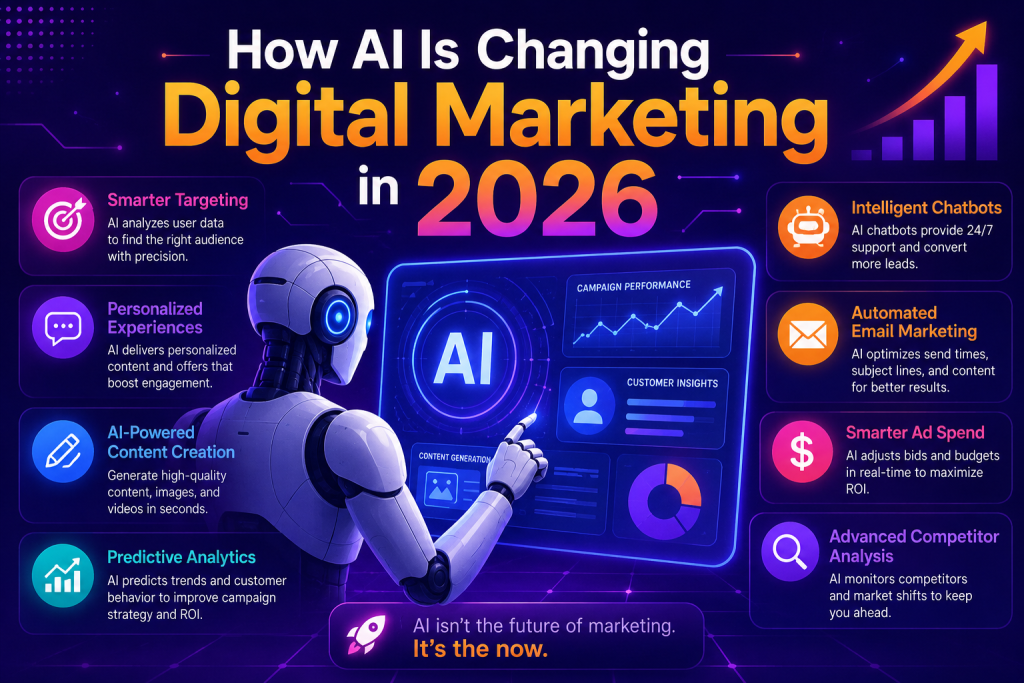
How AI Is Changing Digital Marketing in 2026

How AI Is Changing Digital Marketing in 2026 Five years ago, “AI in marketing” mostly meant a chatbot that could barely answer a shipping question. Today, AI drafts campaigns, writes code for landing pages, predicts which customers are about to churn, and even decides how your brand shows up inside Google’s AI-generated answers. If that shift feels sudden, it’s because it is — and 2026 is the year it stopped being optional. This guide is for anyone who touches marketing: agency owners juggling ten client accounts, solo freelancers competing against teams ten times their size, in-house marketing managers under pressure to do more with less, and students trying to learn a discipline that seems to reinvent itself every quarter. Whether you’re deep into AI SEO already or just getting started with AI marketing tools, this article walks through what’s actually changed, what’s hype, and what to do about it. By the end, you’ll understand what AI in digital marketing really means, why it has become the defining trend of the year, how it’s reshaping more than two dozen marketing functions, which tools are worth your budget, and what mistakes to avoid. Every prediction here is labeled as a prediction — no invented statistics, no imaginary case studies, no promises that AI will “10x your revenue overnight.” Table of Contents 1.         What Is Artificial Intelligence in DigitalMarketing? 2.         Why AI Is the Biggest Marketing Trend of 2026 3.         Top Ways AI Is Transforming Digital Marketing 4.         Best AI Marketing Tools in 2026 5.         Benefits of AI in Digital Marketing 6.         Challenges and Limitations 7.         Real-World Examples 8.         The Future of AI in Digital Marketing 9.         20 Expert Tips for Using AI in Marketing 10.     15 Common Mistakes Marketers Make With AI 11.     Frequently Asked Questions           12 .  Conclusion and Action Plan   1. What Is Artificial Intelligence in Digital Marketing? Definition. AI in digital marketing refers to the use of machine learning, natural language processing, computer vision, and generative models to plan, produce, personalize, distribute, and measure marketing activity — usually with far less manual effort than traditional workflows required. A short history. Marketing automation existed long before anyone called it “AI.” Email autoresponders and rule-based recommendation engines go back to the early 2000s. The real turning point came in two waves: •             Wave 1 (2015–2019): Predictive and programmatic AI. Machine learning models started powering ad bidding, lead scoring, and product recommendations behind the scenes. Marketers rarely interacted with the AI directly; it lived inside platforms like Google Ads and Facebook Ads Manager. •             Wave 2 (2020–2026): Generative and conversational AI. Large language models made it possible for marketers to generate copy, images, video, and code through a simple conversation. This is the wave most people mean when they say “AI marketing” today, and it’s the one this article focuses on. Where things stand now. By 2026, generative AI tools sit inside almost every major marketing platform — not as an add-on, but as the default way work gets done. Search itself has changed too: AI-generated overviews and conversational answers now appear directly in search results, which means marketers are optimizing not just for a ranked list of blue links but for how AI systems summarize and cite their content. Why it matters today. AI has moved from “nice to have” to “how the work gets done” for one simple reason: the volume and speed of marketing tasks has outpaced what human teams can produce manually. Content needs, ad variations, personalization at scale, and real-time customer conversations all demand output that only automation can sustain — while judgment, strategy, and brand voice remain distinctly human responsibilities. Key takeaway: AI in digital marketing isn’t one tool — it’s a layer that now touches research, creation, distribution, personalization, and measurement across almost every channel. 2. Why AI Is the Biggest Marketing Trend of 2026 Every year brings a “trend of the year.” AI’s claim to that title in 2026 rests on four structural shifts, not a passing fad. Market adoption has crossed the mainstream threshold AI tools are no longer confined to enterprise marketing departments with big budgets. Freelancers use AI for keyword research. Small e-commerce brands use it for product descriptions. Agencies use it to scale content production for dozens of clients at once. When a technology is used across every segment of the market, from solo founders to Fortune 500 teams, it stops being a trend and becomes infrastructure. Consumer behavior has changed Buyers increasingly start their research inside AI-powered assistants and AI-generated search summaries rather than clicking through ten blue links. That changes what “being found” means: brands now need to be understandable and citable by AI systems, not just crawlable by traditional search bots. AI-driven search has reshaped visibility Search engines now blend traditional ranked results with AI-generated summaries that answer the query directly. Being the “best result” is no longer enough if that result isn’t the one an AI system chooses to summarize or cite. This has given rise to a new discipline sometimes called AI search optimization or generative engine optimization — essentially, structuring content so AI systems can understand, trust, and reference it. Automation has removed the labor bottleneck Tasks that used to take a content team a week — competitive research, first drafts, image assets, ad variations, and reporting — can now be produced in hours. That doesn’t eliminate the need for human strategists and editors, but it does mean teams that adopt AI well can outproduce and outpace teams that don’t. Competitive advantage is shifting Because AI tools are widely available, the advantage no longer comes from having AI — everyone does. It comes from how well a brand integrates AI into a coherent strategy: better prompting, better editorial oversight, better use of proprietary data, and better judgment about when not to use AI. Shift What changed What marketers should do Adoption AI moved from enterprise to everyone Build AI into everyday workflows, not just special projects Consumer behavior Research often starts in AI assistants Optimize for clarity and

Scroll to Top