The Ultimate Guide to AI & Digital Marketing
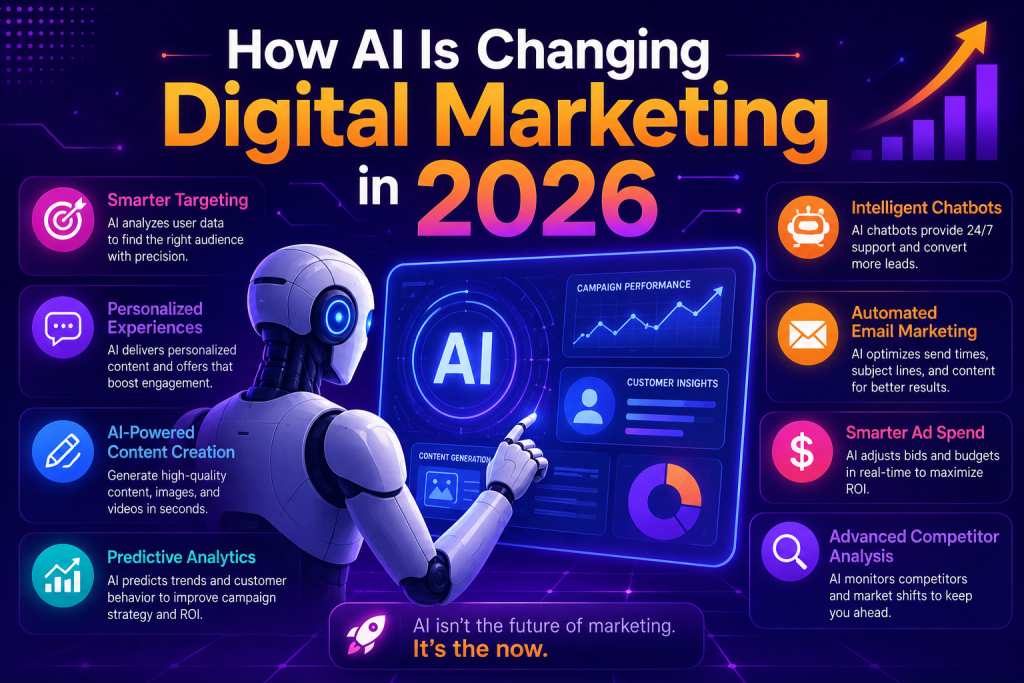
The Ultimate Guide to AI & Digital Marketing Table of Contents 1. Introduction 2. What Is Artificial Intelligence? 3. What Is AI in Digital Marketing? 4. How AI Works in Digital Marketing 5. Why AI Is Transforming Digital Marketing 6. Applications of AI in Digital Marketing 7. Best AI Tools for Digital Marketing 8. Benefits of AI in Digital Marketing 9. Challenges and Limitations 10. AI Marketing Strategies for Businesses 11. How Small Businesses Can Use AI 12. Real-World Case Studies 13. Future of AI & Digital Marketing 14. Common Mistakes to Avoid 15. Best Practices 16. Frequently Asked Questions 17. Conclusion Introduction A decade ago, “marketing automation” meant scheduling a few emails and calling it a strategy. Today, that same word covers software that writes ad copy, predicts which customers are about to churn, bids on keywords in real time, and holds a full customer service conversation without a human ever touching the keyboard. That shift has a name: AI & digital marketing, and it is no longer optional for anyone who wants to compete online. If you run a marketing team, manage a small business, freelance as a strategist, or you’re a student trying to understand where the industry is headed, this guide is built for you. We’re going to walk through what artificial intelligence actually is (without the jargon), how it plugs into every corner of digital marketing — SEO, PPC, content, email, social, analytics — and which tools are worth your time and budget in 2026. You’ll also get the parts most “ultimate guides” skip: the real limitations of AI, the mistakes marketers keep making, and a practical roadmap for small businesses that don’t have a data science team on staff. By the end, you won’t just understand AI in digital marketing conceptually — you’ll have a concrete plan for using it. Key takeaway: AI in digital marketing isn’t a single tool or trend. It’s an operating layer that touches research, creation, distribution, and optimization across every channel you already use. What Is Artificial Intelligence? Before we talk about marketing, let’s get the fundamentals straight — because most confusion about AI marketing tools comes from mixing up these terms. Artificial Intelligence (AI) is the broad field of building machines that can perform tasks that normally require human intelligence — understanding language, recognizing images, making decisions, or spotting patterns in data. Machine Learning (ML) is a subset of AI. Instead of being explicitly programmed with rules, an ML system learns patterns from data. Example: a spam filter that gets better at catching junk email the more email it processes. Deep Learning is a subset of machine learning that uses layered neural networks (loosely inspired by the human brain) to handle much more complex patterns — like recognizing faces in photos or understanding the nuance in a paragraph of text. Natural Language Processing (NLP) is the branch of AI focused on understanding and generating human language. It’s what allows a chatbot to understand “where’s my order?” and respond appropriately, or what lets an SEO tool figure out search intent behind a query. Computer Vision allows machines to interpret images and video — used in ad platforms to automatically tag product photos, or in social platforms to detect what’s inside a video for content moderation and recommendation. Generative AI is the category most marketers interact with daily. These are models (like GPT-based systems or Claude) trained to generate new content — text, images, audio, video, or code — rather than just classify or predict. When a tool writes a blog draft, generates a product image, or drafts ten headline variations, that’s generative AI at work. Did You Know? The term “artificial intelligence” was coined in 1956 at a conference at Dartmouth College — decades before anyone imagined it would be writing Instagram captions. Understanding this hierarchy matters because when someone says “we use AI for marketing,” they could mean anything from a simple rules-based automation to a large language model generating full campaigns. Precision here helps you evaluate tools accurately instead of buying into hype. What Is AI in Digital Marketing? AI in digital marketing refers to the use of machine learning, NLP, computer vision, and generative AI to plan, create, distribute, personalize, and optimize marketing activities — with far less manual effort than traditional methods required. Practically, this means: • Software that analyzes customer data and predicts what they’ll do next • Tools that generate ad copy, blog posts, or product descriptions in seconds • Systems that automatically adjust ad bids based on real-time performance • Chatbots that handle customer questions 24/7 • Algorithms that decide which email subject line will get the most opens, and send it Why has AI become essential? Three forces converged: data volume exploded beyond what humans can manually analyze, generative AI became genuinely useful (not just a novelty) around 2022–2023, and customer expectations shifted toward instant, personalized experiences. Industry adoption reflects this. Surveys from marketing research firms consistently show that a majority of marketing teams now use AI tools in at least one part of their workflow — most commonly content drafting, data analysis, and customer segmentation. The laggards aren’t skipping AI because it doesn’t work; they’re skipping it because of unclear strategy, not lack of value. Expert insight: The marketers seeing the best results aren’t the ones using the most AI tools — they’re the ones who’ve mapped AI to specific, measurable bottlenecks in their existing workflow. How AI Works in Digital Marketing It helps to think of AI’s role in marketing as a pipeline with five stages. 1. Data Collection AI systems pull in data from websites, CRMs, ad platforms, email tools, and social channels — page views, purchase history, click patterns, time on site, device type, and more. 2. Data Analysis Machine learning models process this data to find patterns a human would miss — like the fact that customers who view a pricing page twice within 48 hours convert at 3x the average rate. 3. Prediction Based